EXECUTIVE TAKEAWAY
Microsoft has announced that usage-based billing will be enabled by default for newly purchased Microsoft 365 Copilot Business licences from 2 November 2026.
The per-user Microsoft 365 Copilot Business licence remains the foundation. From 2 November 2026, newly purchased Microsoft 365 Copilot Business licences will also have usage-based billing enabled by default for eligible metered experiences, with consumption charged separately through Copilot Credits when those experiences are used.
Partners have a genuine reason to contact customers already considering Copilot Business, while keeping the message accurate and avoiding pressure-led selling.
This change makes it simpler for SMB customers to access premium Copilot services alongside the licensed Copilot Business experience, but it also makes consumption policy, spend controls and AI FinOps a required part of the partner conversation.
Formal Note: Microsoft has announced an important change to how usage-based AI services will be enabled for new Microsoft 365 Copilot Business customers.
Starting 2 November 2026, usage-based billing will be turned on by default for newly purchased Microsoft 365 Copilot Business licences. This does not replace the per-user licence. Instead, it adds a consumption layer for eligible AI services that sit beyond the everyday capabilities included with the user licence.
Read the Microsoft Partner Center announcement
For partners, this is more than a billing administration update. It changes the conversation customers need to have when adopting Copilot Business, agents and more advanced AI workloads.
Read this alongside Adam’s companion article
Adam Smith’s companion article, The New Copilot: Your Opportunity As A Partner, makes the bigger partner argument: the AI conversation has moved beyond “what can Copilot do?” and into “how do customers operationalise AI inside their business?” Adam’s framing is that the partner opportunity is no longer just about selling licences, but about helping customers govern AI, roll it out safely, measure success and turn experimentation into repeatable value.
This article picks up the commercial reality underneath that opportunity.
As Microsoft brings Copilot, Cowork-style work, code, Autopilot and agentic workloads closer together in the user experience, partners need a clearer story for customers around what is license-included, what may be metered, what is capped, who controls spend and how usage is reviewed over time.
In simple terms:
- Adam’s article explains why this is a partner opportunity.
- This article explains how partners can turn that opportunity into a practical commercial, governance and AI FinOps conversation.
- Together, they help partners move from a license-led discussion to an operating-model discussion.
The simple version
Microsoft 365 Copilot licensing remains the foundation.
The per-user licence gives an eligible user access to Microsoft 365 Copilot experiences across their everyday flow of work. The updated announcement does not mean every Copilot interaction becomes metered. Instead, Microsoft 365 Copilot Business combines a user subscription licence foundation with a default-enabled usage-based billing layer for eligible advanced, agentic or long-running workloads where consumption is measured separately.
- The “Business” licence provides a consistent, predictable baseline for Microsoft 365 Copilot experiences.
- Usage-based billing scales according to the amount and complexity of work being performed.
- More advanced agents, workflows and API-driven scenarios can be metered through Copilot Credits.
IN ONE SENTENCE
Microsoft 365 Copilot Business customers are moving toward a model where every day licensed Copilot value sits alongside metered consumption for eligible advanced AI work. The license remains the foundation; usage-based billing applies only when eligible metered services are used.
The experience is converging
The product conversation is also changing. Microsoft’s direction is to make Copilot feel less like a set of disconnected tools and more like a unified entry point for work.
The important partner message is this: the customer experience may become simpler, but the partner conversation needs to become more deliberate.
Microsoft is moving toward a more unified Copilot experience where chat becomes the starting point for everyday productivity, Cowork-style execution, code-related work, Autopilot-style personal assistance and other premium AI workloads. Rather than asking users to decide which product experience to open first, Copilot increasingly routes work from a chat-led experience into the right capability.
For SMB customers, this matters because premium AI workloads become easier to discover and easier to start using.
For partners, this matters because easier access increases the need for:
- workload approval,
- billing ownership,
- spend guardrails,
- model and workload policy,
- usage visibility,
- value measurement,
- and regular optimisation.
The commercial story is not “Copilot is becoming metered”. That would be too simplistic. The better explanation is that Copilot is becoming a broader AI work platform, where licensed productivity use and premium metered execution can sit side by side.
Key clarification: USL versus UBB
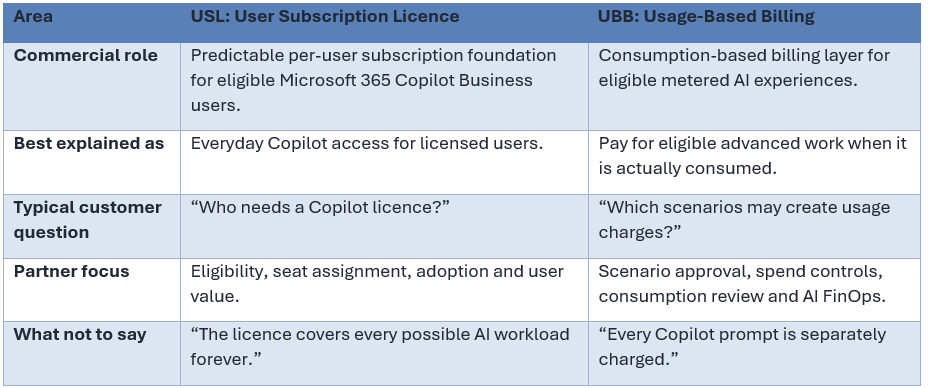
Microsoft’s updated framing separates the baseline user licence from consumption-based usage. In partner conversations, this matters because customers may hear “usage-based billing default-on” and assume the whole Copilot Business product is becoming pay-as-you-go. That is not the right message.
USL stands for User Subscription Licence. It represents the per-user Microsoft 365 Copilot Business subscription that gives eligible users access to everyday Copilot experiences under the applicable product terms.
UBB stands for Usage-Based Billing. It is the consumption layer for eligible metered AI experiences, where charges are created only when those eligible services are used. It should not be positioned as an additional fixed monthly charge for every user by default.
For customers, the practical explanation is simple: they still need the per-user licence, and they may also incur consumption charges when users or agents access eligible usage-based experiences. Partners should explain both layers together, then discuss billing ownership, spending controls, alerts and regular usage reviews.
One of the most important practical clarifications for partners is the discussed default spend cap for usage-based Copilot workloads.
Based on the current Microsoft partner clarification, newly purchased Copilot Business usage-based billing is expected to have a default per-user, per-month pay-as-you-go spend limit of $40 for eligible usage-based workloads. Customers are expected to be charged only for the Copilot Credits they consume, up to the configured guardrail, and organisations may have flexibility to adjust that limit based on business need and policy.
Partners should position this carefully.
The $40 cap: helpful guardrail, not a blank cheque
The $40 cap should be treated as a cost-exposure control, not as an all-inclusive premium services bundle. It does not mean every workload is included, nor does it remove the need for customer approval, consumption reporting or monthly review.
Recommended partner wording:
“Microsoft is making it easier for SMB customers to access premium Copilot workloads by enabling usage-based billing by default for new Copilot Business purchases from 2 November 2026. The per-user Copilot Business licence still applies, and eligible metered workloads are charged only when consumed. Microsoft’s current partner clarification points to a default $40 per-user, per-month spend guardrail for usage-based Copilot workloads, which helps limit cost exposure while giving customers a simpler path into premium AI scenarios. We should still validate final product terms, workload scope and customer settings before treating this as a fixed public commitment.”
What is changing on 2 November 2026?
The new Microsoft announcement applies specifically to new Microsoft 365 Copilot Business licences.
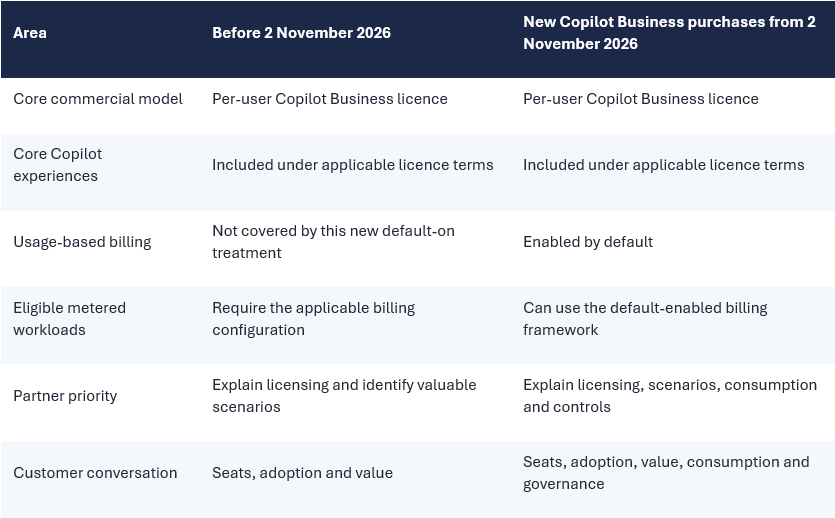
The key point is that usage-based billing does not make every Copilot interaction chargeable, and it should not be described as a replacement for the user licence.
The user subscription licence remains the baseline for everyday Microsoft 365 Copilot Business access. Metered billing applies to eligible usage-based services, with the relevant workload, availability, billing configuration, spend controls and product terms determining whether consumption is charged.
What is not changing?
Partners should avoid creating the impression that Microsoft 365 Copilot Business is turning into a completely consumption-based product.
- Customers still purchase a per-user Copilot Business licence.
- Copilot Business remains designed for eligible Microsoft 365 Business customers.
- The product remains subject to its eligibility and tenant seat limits.
- Microsoft 365 Copilot remains the relevant option for users with eligible enterprise plans or customers outside Copilot Business eligibility.
Eligibility: Microsoft 365 Copilot Business is positioned for customers with eligible Microsoft 365 Business Basic, Business Standard or Business Premium subscriptions, with a maximum of 300 Copilot Business seats per tenant. Enterprise-plan users require the standard Microsoft 365 Copilot offer. Mixed tenants may contain both licence types where each user has an eligible underlying plan.
The JX Reality Filter
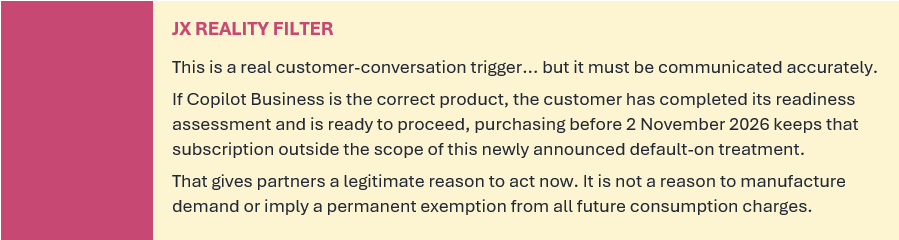
What partners should not say
- “Buy before 2 November and you will never pay for usage.”
- “All AI usage becomes chargeable after 2 November.”
- “Microsoft 365 Copilot Business becomes a pay-as-you-go licence.”
- “Purchasing before the date guarantees permanent exemption.”
The announcement addresses the default billing setting for new Microsoft 365 Copilot Business licences from 2 November 2026. It does not confirm how every later renewal, additional seat, upgrade, transition or newly released metered service will be treated, so partners should avoid promising permanent exemption or fixed future outcomes.
Recommended partner wording
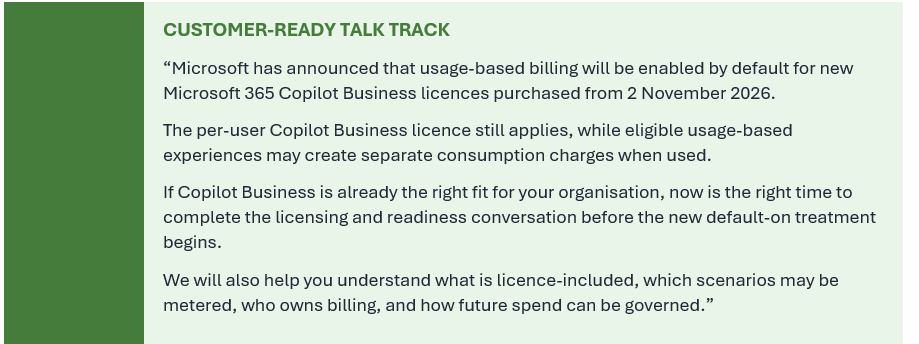
Why this matters to customers
The opportunity
Usage-based services allow customers to move beyond individual AI assistance and into scenarios where AI can:
- Complete multi-step work.
- Operate across apps and systems.
- Use agents to execute repeatable processes.
- Support more complex reasoning and orchestration.
- Deliver complete outcomes rather than only drafting or answering questions.
This creates a pathway from personal productivity to business-process transformation.
The governance implication
When consumption is available by default, customers need greater visibility over:
- Who can access usage-based services.
- Which scenarios are approved.
- Who owns the associated billing.
- How spending limits and alerts are configured.
- How usage is reviewed against business value.
- How dormant, duplicated or low-value agents are managed.
AI FinOps becomes a partner service motion
This is where the partner opportunity becomes much more interesting.
As customers move from everyday Copilot usage into Cowork, agents, code, Autopilot and other longer-running AI workloads, they will need a practical way to manage cost, usage and value. That is the role of AI FinOps.
AI FinOps is not just cost reduction. It is the operating discipline that helps customers answer:
- Which AI workloads are approved?
- Who is allowed to consume premium workloads?
- Which teams or users should have access to higher-cost scenarios?
- What is the monthly budget or cap?
- What value is being returned from the consumption?
- Which agents or tasks are active, dormant, duplicated or low-value?
- Where should the customer invest next?
For partners, this creates a new managed-service opportunity. Instead of selling Copilot Business as a once-off licence transaction, partners can package ongoing value around:
- Copilot Business Readiness Review,
- AI FinOps Setup,
- Metered Workload Approval Framework,
- Monthly Copilot Value and Consumption Review,
- Agent and Cowork Governance Review,
- and ongoing optimisation of usage toward high-value business processes.
The point is not to make customers afraid of consumption. The point is to help them consume intentionally.
What partners should do now
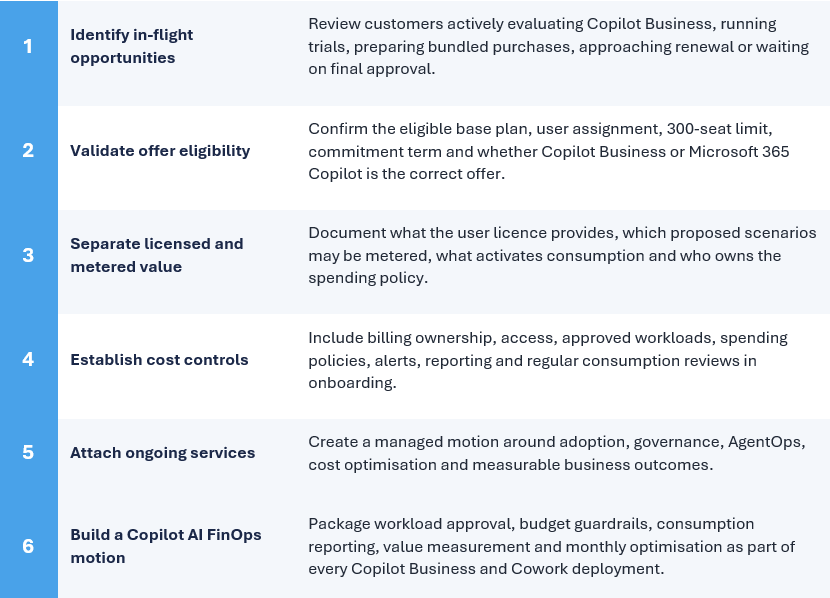
The partner opportunity
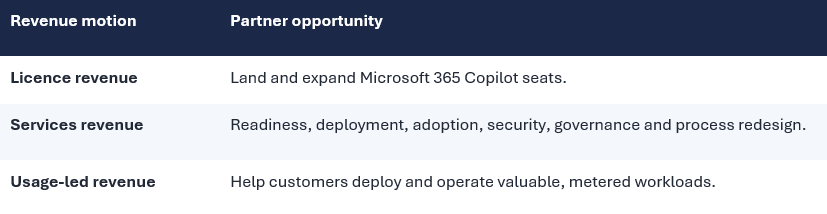
This shift creates three complementary revenue motions:
What a top 1% partner would do
A top-performing partner would not simply send a deadline email. They would create a repeatable Copilot Business Readiness and Consumption Review that includes:
- Licence and eligibility validation.
- Scenario discovery.
- Security and data-readiness assessment.
- Licensed-versus-metered workload mapping.
- Consumption forecasting.
- Spending-control design.
- Adoption planning.
- Monthly value and cost reviews.
COMMERCIAL OUTCOME
This turns a licence transaction into an ongoing managed AI relationship.
What a top 1% partner would do next
A top 1% partner would not treat this as a billing announcement. They would turn it into a customer operating model.
They would build a repeatable Copilot Business and AI FinOps offer that includes:
- licence and eligibility validation,
- user and workload segmentation,
- included-versus-metered workload mapping,
- Cowork and agentic use-case discovery,
- budget and cap configuration,
- approval pathways for premium workloads,
- reporting for consumption and business value,
- and a monthly optimisation review.
The strongest partners will also create a simple customer-facing decision matrix:
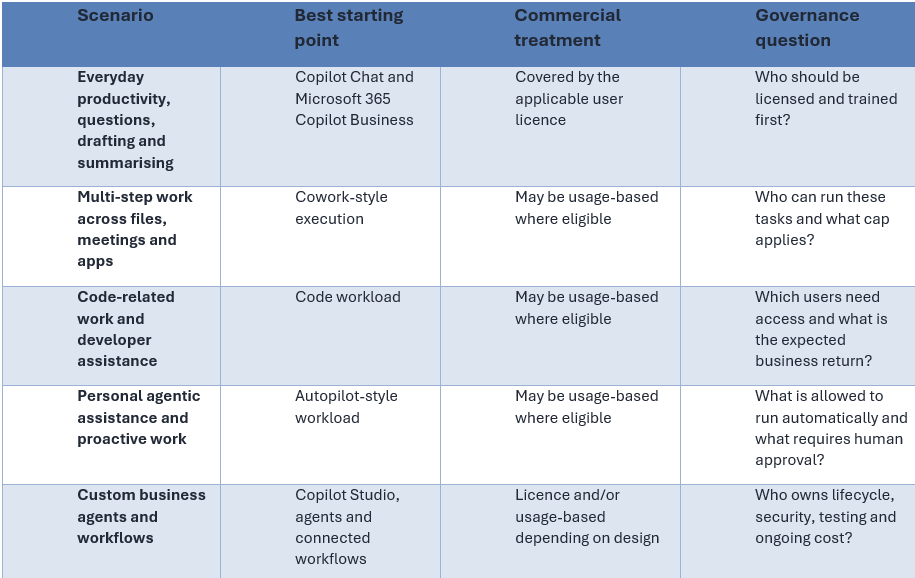
This is the shift partners should lean into: from “Do you want Copilot?” to “How do we help you operate AI responsibly, affordably and at scale?”
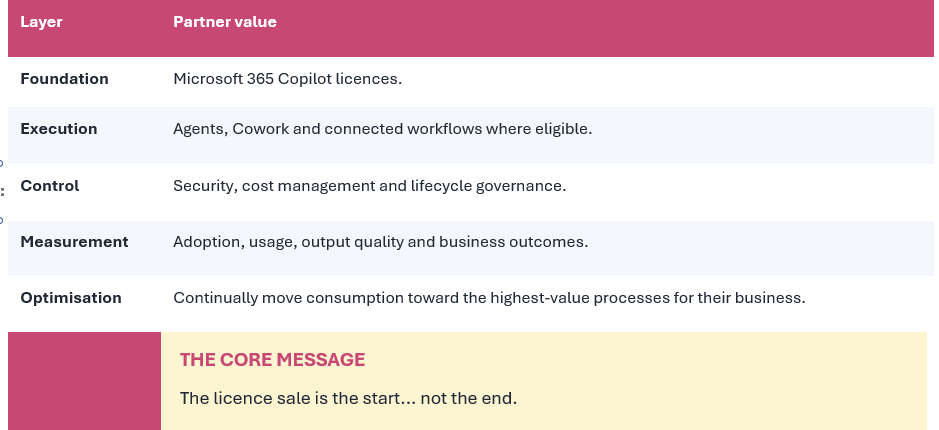
How to disrupt the current approach
Most partners still treat Copilot as a seat-led software sale. The disruptive approach is to package it as an AI operating model:
Final partner takeaway
The 2 November change gives partners a clear reason to re-engage customers already considering Microsoft 365 Copilot Business.
- There is a genuine timing consideration.
- Customers purchasing before 2 November are outside this specific default-on change.
- Customers should not purchase an unsuitable product simply to beat a date.
- Usage-based billing does not replace the Copilot user licence. Partners should explain USL and UBB together: USL provides the predictable per-user baseline, while UBB applies to eligible metered experiences when consumed. We are continuing to validate final public wording with Microsoft, including which Copilot Business experiences are licence-included, which scenarios may trigger metered consumption, and how future model or agentic capabilities are treated under this billing shift.
- Strong cost governance should be part of every future deployment.
- Partners have an opportunity to build recurring services around adoption, agents, governance and AI FinOps.
BALANCE URGENCY WITH TRUST
Create urgency, stay accurate and attach services to the outcome.
Confirmed versus still validating
To keep this article partner-ready and commercially defensible, partners should separate confirmed public guidance from items still being validated with Microsoft.
Confirmed publicly
- Microsoft has announced that usage-based billing will be enabled by default for newly purchased Microsoft 365 Copilot Business licences from 2 November 2026.
- The per-user Copilot Business licence remains the foundation.
- Usage-based billing does not mean every Copilot prompt or interaction is separately charged.
- Eligible metered experiences may consume Copilot Credits when used.
- Partners should help customers understand licensing, consumption, billing ownership, cost controls and governance.
Still being validated with Microsoft
- Final public wording for the unified Copilot experience where chat, Cowork-style work and premium workloads are surfaced together.
- Exact public scope of the $40 per-user, per-month default usage guardrail.
- Which workloads are included under the cap at launch.
- How Cowork, code, Autopilot-style scenarios and future agentic workloads are treated across SMB and CSP purchasing motions.
- Any differences between public preview, Frontier, NDA briefing language and final generally available product terms.
JX Reality Filter
The opportunity is not “sell before the billing change”. That is too small.
The bigger opportunity is this:
Microsoft is making advanced AI capability easier for SMB customers to access. That lowers friction, but it also increases the need for partner-led governance.
The partner that can explain what is included, what is metered, what is capped, what needs approval and how value is reviewed monthly becomes the trusted AI operator... not just the licence reseller.
Sources and collaboration notes
Primary public source: Microsoft Partner Center, September 2026 announcements.
Additional Microsoft guidance should be validated against public Microsoft Learn and Partner Center materials before publication. The internal UBB briefing was used only to improve framing and partner readiness language, not as a direct external source.
Usage-based billing default-on announcement
Read more from Microsoft
- Understand usage-based billing and cost management for Copilot Credits
- Managing AI experiences enabled by usage-based billing
- Copilot Credits Guide
Supporting internal references used in developing the partner framing: Cowork Partner GTM Playbook and Microsoft 365 Copilot Business Launch FAQ for Partners. Validate final commercial claims against the latest Microsoft Partner Centre announcement, price list, offer matrix and applicable product terms before external publication.

Microsoft Momentum October 2026 Edition - AI Innovation, Marketplace Growth and New Opportunities Ahead

The New Copilot: Your Opportunity As A Partner

Why Microsoft Purview Upskilling Is Now Mandatory for MSPs in the Age of Copilot and AI
Copilot Chat: A Safe, Practical First Step into AI for ANZ Businesses